I had, together with Casper Widd, another intern at the Hertonäs Manor museum during the summer, the opportunity to interview the former chairman of the association Svenska Odlingens Vänner i Helsinge, Mikael Westerback, as part of the internship. (Hertonäs manor museum is run by the association Svenska Odlingens Vänner i Helsinge, hereafter referred to as the abbreviated SOV). Westerback, who was chairman for 33 years (1992–2025), has been incredibly important in shaping the museum to what it is today, especially concerning the Cronstedt exhibition on the second floor, and, after his resignation from the position earlier this summer, it became relevant to collect some of the oral information he holds, in the form of an interview.
During the interview, a variety of topics were discussed, including the Cronstedt exhibition, various deposited museum objects, some of the many restorations over the decades, the museum, the parks, the association and much more. Another interesting thing that was discussed was the Cronstedt grave chapel at the Church of St. Lawrence in Vantaa.
Vice admiral Carl Olof Cronstedt was one of the most important former owners of Hertonäs manor. The Vice admiral lived on the farm with his family on two occasions, the first time between the years 1793–1799. After a time in Sweden, Cronstedt bought the manor a second time in 1813, and lived here until his death in 1820, when his wife Beata Sofia Wrangel af Sauss took over the manor. Both the Vice admiral and his wife are buried in the Cronstedt grave chapel.
Westerback says that for over 15 years he had discussed the future of the grave chapel with the descendants of the Cronstedt family. The grave chapel was falling into disrepair, and since no one after Carl Olof Cronstedt and Beata Sofia Wrangel af Sauss had been buried in the burial chapel, the descendants had neither the interest nor the resources for the restoration and upkeep of the burial chapel, and had therefore contacted Westerback to see if the association would be interested in taking over the historic grave chapel. In order for the grave chapel to pass into the association's ownership, the family's descendants had to relinquish their burial rights and allow the change in ownership. The burial chapel was also in need of restoration, and Westerback says that with the help of various grants from foundations and associations, the burial chapel was successfully restored before the association SOV took it over. Westerback also says that he took special care to understand grave chapels, both inside and out, in order to be able to follow the work of restoring the Cronstedt grave chapel. After an announcement in HBL, the descendants announced that they were waiving their burial rights and transferring the chapel over to SOV. The congregation also accepted the transfer. The restoration was carried out under the supervision of the Finnish Heritage Agency.
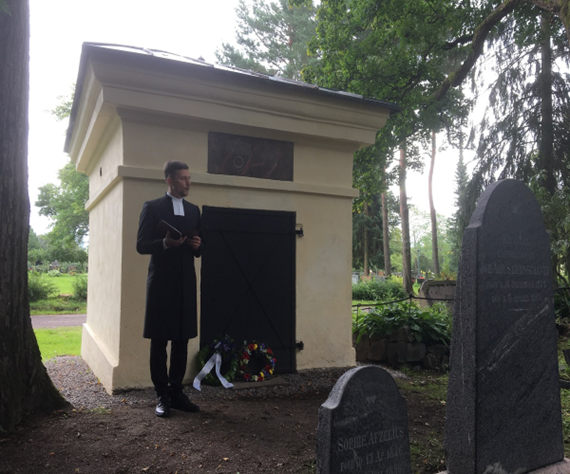
Vicar Kristian Willis blessed the chapel at a ceremony witnessed by about 40 descendants. Photograph: Andreas Koivisto, 2023, The re-inauguration of the Cronstedt grave chapel, Svenska Odlingens Vänner i Helsinge r.f. (SOV).
The interview with Mikael Westerback took place in the main hall on the second floor of the museum, where various objects owned by the Cronstedt family are on display. Concerning discussions about the grave chapel, two framed works in the room were highlighted. One of these was an etching depicting the burial chapel, which came to the museum earlier this year. Westerback says that the etching came via the current chairman of the association, Andreas Koivisto, whose grandmother Ulla-Stina Westman (who was vice chairman of SOV) had the etching.
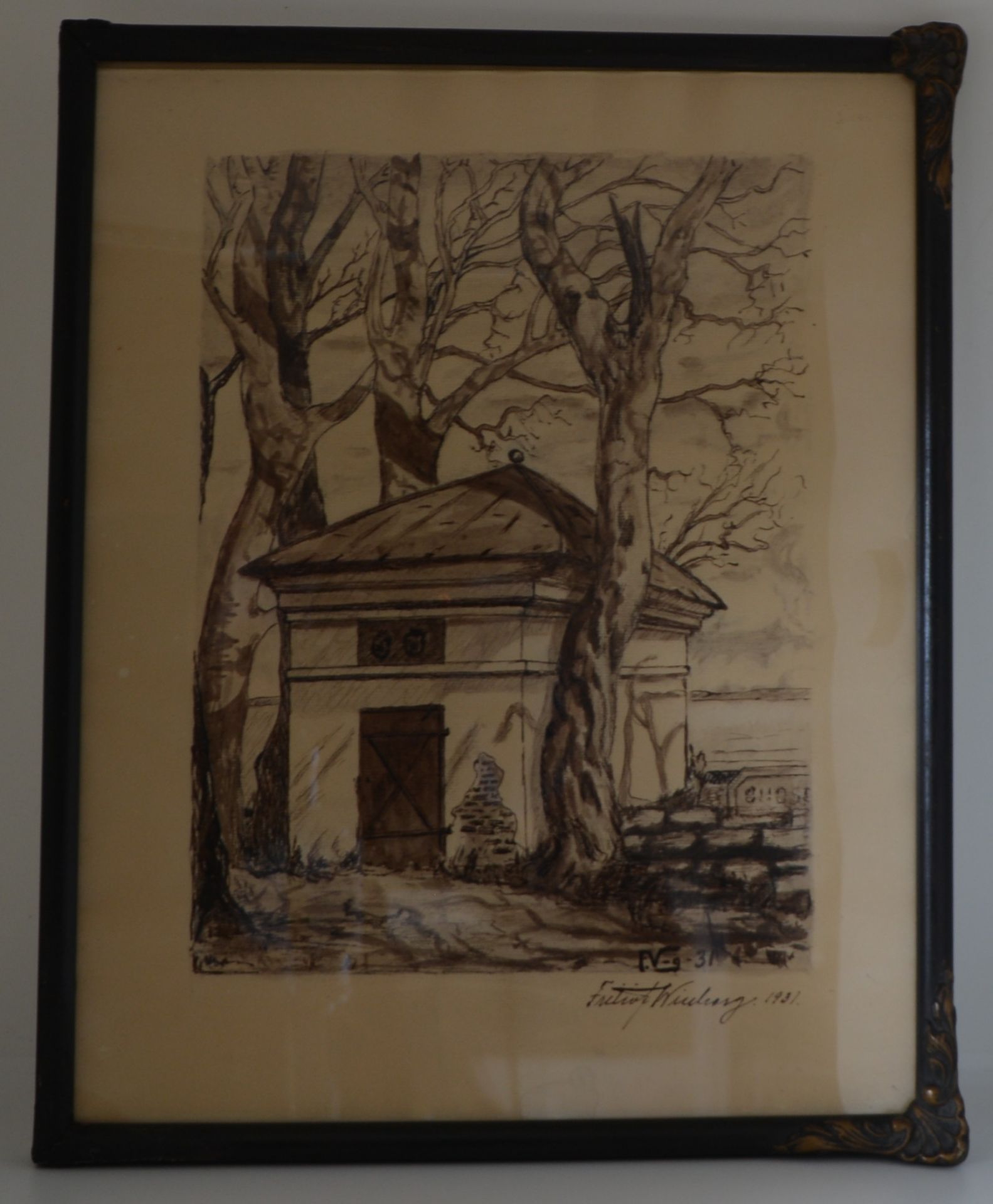
Etching of the grave chapel, Svenska Odlingens Vänner i Helsinge r.f. (SOV) (Photograph: Viivi Heinonen, 20.8.2025)
The other work discussed is displayed very close by, hanging on the wall above the chiffonier on which the etching is displayed; an unsigned drawing of the grave chapel. Westerback says that the grave chapel was most likely designed by Pehr Granstedt, who also designed the new main building for Hertonäs manor when Vice admiral Cronstedt moved back to Hertonäs manor in 1813. The grave chapel closely resembles the southern, square gazebo in the Hertonäs park. It was designed by Carl Ludvig Engel before 1820. Westerback also visited the Aminoff grave chapel in Bromarv, designed by Engel, and the von Born grave chapel in Pernå, designed by Pehr Granstedt. Everything indicated that it was Granstedt who designed the relatively simple and smaller chapel in Vantaa.
The Cronstedt exhibition, the gazebos in the park, the etching and the drawing of the grave chapel, as well as a key to said grave chapel can all be seen at Hertonäs manor museum.
Viivi Heinonen’s local history internship at Hertonäs manor museum has been funded by the Swedish Cultural Foundation in Finland.