In the summer of 2025, an interview was held with Mikael Westerback, the recently retired chairman of Svenska Odlingens Vänner i Helsinge rf. (SOV). The interview was conducted by Hertonäs manor’s summer interns Viivi Heinonen and Casper Widd, and the aim of the interview was to document Mikael Westerback's memories from his time as chairman and at Hertonäs manor. Ahead of the interview, around twenty questions had been prepared, some of which concerned Hertonäs manor’s park. During the interview, information emerged about the threats and changes that Hertonäs manor's park and fields have been exposed to over the years.
Before we delve into the more recent history of Hertonäs manor’s park, it may be useful to first review the park's background. During the 18th century, interest in gardening and landscaping increased at vicarages and manor houses, and symmetrical gardens with ornamental and useful plants began to be created. This trend also influenced the owners of Hertonäs manor from that time onwards. There was already a garden next to the old main building by the beach in the 18th century. A map from 1769 shows that there was a large herb garden on a sheltered slope connected to the manor house, which was probably intended for the cultivation of useful crops and plants.
There is an unsigned sketch of the garden at the old main building that probably dates from Bengt von Spången's time at Hertonäs in the 1760s. The sketch shows symmetrical cultivation areas and paths, as well as a tree circle.
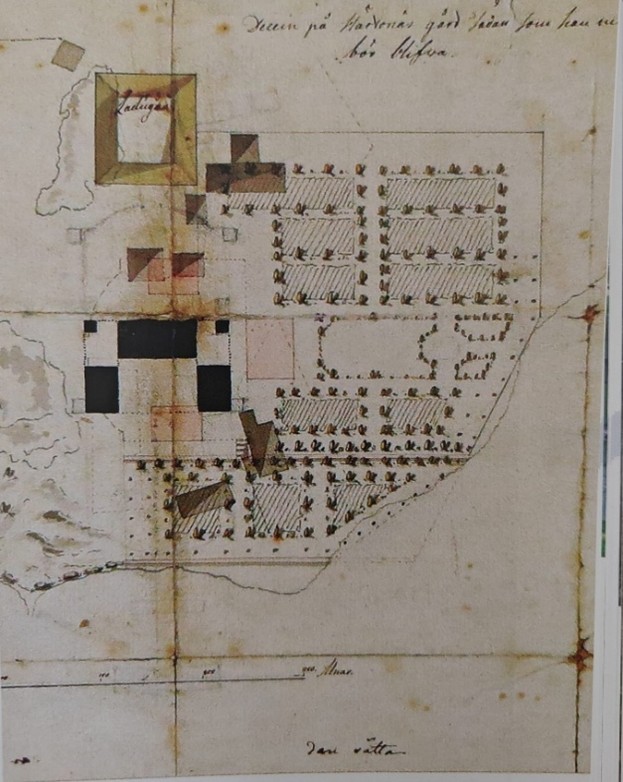
(Caption: Image of a sketch of Hertonäs manor from the 1760s, artist unknown. The image is taken from page 67 of Sigbritt Backman's book: ‘Hertonäs gård – Från säterier till museum’ (Hertonäs Farm – From Manor House to Museum) from 2017, image: Casper Widd 18.8.2025.)
When Carl Olof Cronstedt returned to Hertonäs manor in the 1810s, he had the current French Baroque park laid out next to his new main building, and it is very possible that Cronstedt also had the English park laid out on the edge of the French park. Cronstedt also commissioned the designs for the two gazebos in Hertonäs manor Park. The pleasure houses were designed by Carl Ludvig Engel. Engel's drawings also show that an obelisk was planned for the park, but it was never erected. Cronstedt also had plans to build an orangery at Hertonäs manor. The drawings were commissioned from Fredrik Blom, but the orangery was never built.
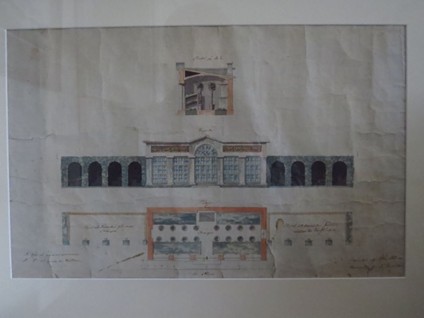
(Caption: (Tavla, S200:F0870, Hertonäs gårds museum fysiska samlingar (I.6 – 10. Cronstedtska samlingen)) Photograph of Fredrik Blom's drawing of the planned orangery, Photo: Martin Backman, 2021. The image is taken from Svenska Odlingens Vänner I Helsinge rf. (SOV)’s Desky, 19.8.2025.)
With Cronstedt's changes, the park at Hertonäs manor took on a form similar to what it still has today. Changes have taken place and trees and bushes have come and gone, but on the whole, the park remains in a similar form to that during Carl Olof Cronstedt's time at Hertonäs.
In the interview with Mikael Westerback, it emerges that Hertonäs manor and the Helsinki City Council have had an agreement since the 1950s that the City of Helsinki will maintain Hertonäs manor park in exchange for Helsinki residents being able to visit the park free of charge. This agreement was renewed in the 1990s because (SOV) was dissatisfied with how the city was managing the park. Since the renewal of the agreement, the City of Helsinki has taken better care of the park, which the (SOV) board is pleased with.
In the 1990s, a threat arose to the farmland of the manor. During the 1990s, the oil port in Hertonäs had been closed down and the City of Helsinki had begun a project to build residential areas in Hertonäs. Westerback and the board felt that the City of Helsinki was acting rather harshly when it came to the Hertonäs manor's property. Among other things, they had plans to build a golf course on the manor's farmland, which they had no real right to do, as the Hertonäs manor is private land.
In the 2010s, a new problem had also arisen for the City of Helsinki. As traffic to Santahamina and Laajasalo had increased in the early 2000s, the City of Helsinki had decided to widen the road next to the Hertonäs manor. As they could not take space from the residential area on the other side of the road, the City of Helsinki planned to widen the road towards the Hertonäs manor’s park, i.e. to demolish the part of the park adjacent to the road and use the space for road construction.
(SOV) naturally opposed this, as they wanted to preserve the park in its 19th century state, and the association was also supported by residents' associations, the Helsinki City Museum, the Finnish Heritage Agency and park experts, who also opposed the plan. Among other things, the City of Helsinki argued that the park's stone wall was probably a modern structure and therefore did not need to be protected, but as the association has documents showing that the wall belonging to the park was built so long ago, the claim that the wall was modern could be refuted.
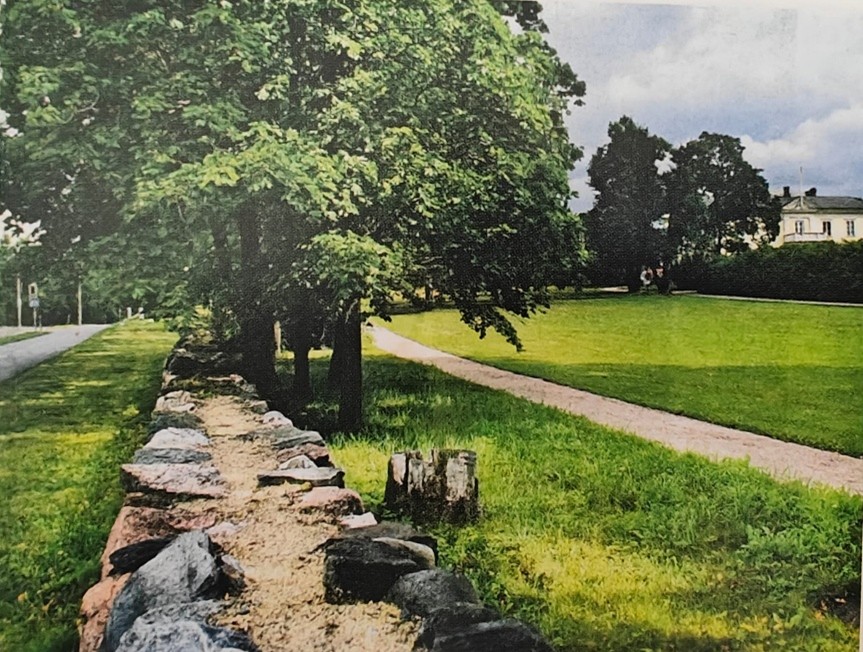
(Caption: Photograph of a picture of the wall that would have been removed for the road widening, the image is from an article from Hufvudstadsbladet, August 2011, Photo Cata Portin. The picture is taken from page 193 in Sigbritt Backman's book: ‘Hertonäs gård - Från säterier till museum’ from 2017 (Photo: Casper Widd 18.8.2025.)
Today, in 2025, the park still stands in its 19th century style. The park is cared for, flowers and plants are planted and removed, paths and lawns are maintained and everything is looked after. Mikael Westerback himself states that the association (SOV) is very pleased that the park is maintained.
Casper Widd's local history internship at Hertonäs Manor Museum has been funded by the Swedish Cultural Foundation in Finland.
Literature:
Sigbritt Backman 2017, Hertonäs gård - Från säterier till museum
Pages: 67 - 69, 72 - 73.
Interview with Mikael Westerback, former chairman of Svenska Odlingens Vänner i Helsinge rf. (SOV), 13 August 2025.