There are three white marble sculptures in the red salon of the main building at Hertonäs Manor. Each sculpture is a reproduction of a well-known work of art. There are two sculptures depicting sitting boys, and one depicting a standing woman. All have come to be in possession of the museum through the estate of Helene Bergbom.
The musically gifted Helene Gustava Gripenberg, who had also worked as a teacher, married John Bergbom in 1882. John, who was particularly interested in agriculture, grew up on the Hertonäs Manor. The couple spent 35 years together on the manor, until John was shot in his home by a group of armed red guards in November 1917, after which Helene soon moved away from Hertonäs. Finally, it was decided that Hertonäs Manor would be donated to Svenska Odlingens Vänner i Helsinge r.f. (SOV), an association John Bergbom had been a member of. The association SOV maintains the Hertonäs Manor Museum to this day.
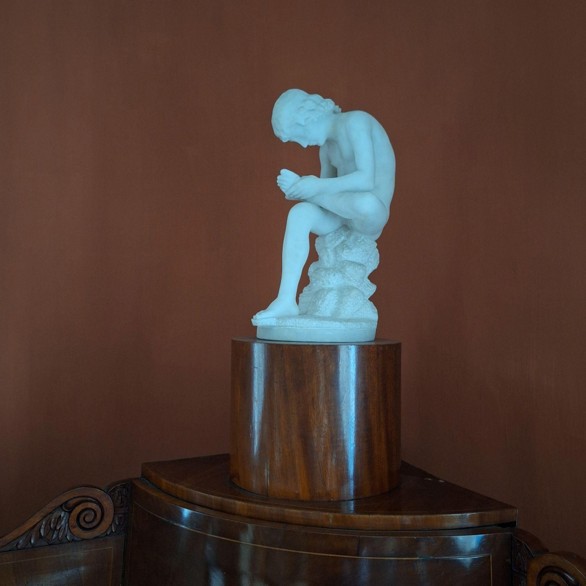 Photograph: Viivi Heinonen, artist: unknown, Spinario, Svenska Odlingens Vänner i Helsinge r.f. (SOV) C.C. B.Y. 4.0.
In the southeast corner of the salon, above the sofa, is a crouching figure inspecting the sole of his foot. The original Hellenistic bronze sculpture, called Spinario, Thorn puller, Fedelino, or Boy with thorn, is in Rome, in the Capitoline Museums. The motif has inspired artists and art collectors long after the heyday of the Roman empire, both in the form of painting and sculpture, and reproductions such as the one found in the Bergbom home on Hertonäs Manor, were very common.
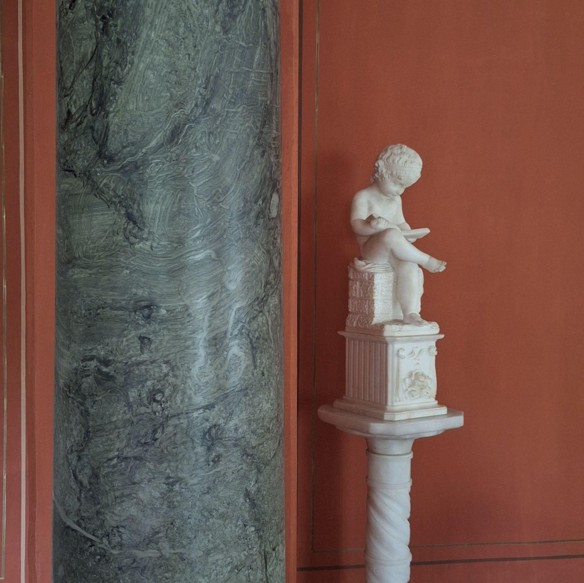 Photograph: Viivi Heinonen, artist: unknown, Reading child, Svenska Odlingens Vänner i Helsinge r.f. (SOV), C.C. B.Y. 4.0.
On the other side of the room, on a pedestal, sits a small figure in a very similar position, with one leg raised over the other knee and a book in his arms. This is a reproduction of a very common motif; “the reading boy”. The motif exists in countless versions, both in stone and porcelain, sometimes sold in pairs as Reading Girl and Writing Boy. The name of the Italian neoclassical artist Antonio Canova (1757–1822) is engraved on the book. There are plaster casts made under the direct supervision of Antonio Canova, which have “ANTONIO CANOVA” engraved into them, which could indicate that even if Canova did not sculpt the original, which the Hertonäs Manor’s Reading Boy was made after, he may have still had a hand in the reproduction process.
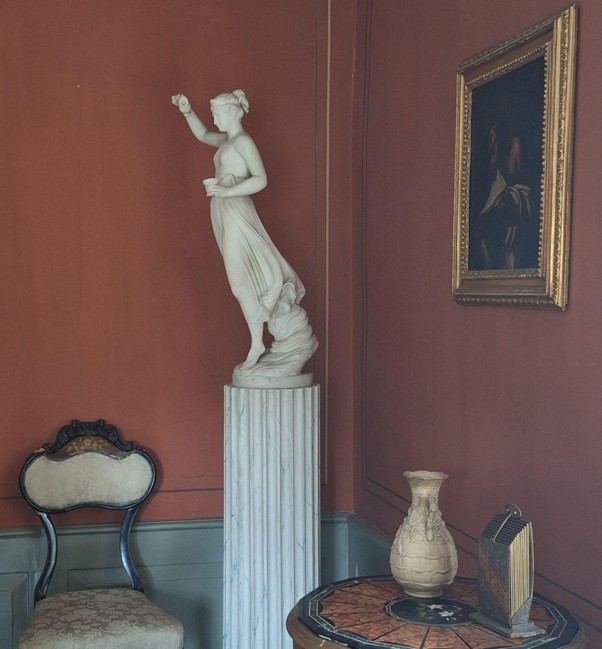
Photograph: Viivi Heinonen, artist: unknown, after Antonio Canova, Hebe, Svenska Odlingens Vänner i Helsinge r.f. (SOV), C.C. B.Y. 4.0.
The third sculpture depicts a standing woman in motion, with one arm outstretched. She stands in the northeast corner of the room, dressed in a heavily pleated cloth, which is tied around her waist. She holds objects in both hands. The sculpture is a reproduction of a sculpture made by Antonio Canova. The original is in the collections of the Hermitage, in Saint Petersburg. The sculpture depicts the goddess of youth, Hebe, who, together with Ganymede, served as the cupbearer of the gods.
All three sculptures are reproductions of well-known older works. This does not, however, diminish their value as museum objects. In addition to being part of the interior design, the sculptures can also be seen to have another function.
The classical influence is visible in the salon, in addition to the sculptures, which all refer back to antiquity in their own way, also in the two ionic columns that divide the room. The owners of the estate have put effort and care into the interior design both for their own enjoyment, as well as the appreciation of visitors. The salon also contains photo albums that belonged to Helen, with pictures from Italy as well as the 1889 Paris Exposition. Both foreign trips and works of art with clear connections to Italy have influenced the communicated cultural capital.
The three sculptures in the salon at Hertonäs Manor have functioned both as beautiful art objects, but also as messengers, communicating the owners’ wealth, internationality, and their knowledge of fine arts. Since the objects at Hertonäs Manor Museum are today not only exhibited as museum objects, but also as objects once owned by the manor’s previous owners, they represent these previous owners; their thoughts and opinions, their identity.
Viivi Heinonens local history internship at Hertonäs Manor Museum has been funded by the Swedish Cultural Foundation in Finland.
Literature:
Backman, Sigbritt 2016. Herttoniemen kartano – Säteritiloista museoksi, Helsinki: Svenska Odlingens Vänner i Helsinge r.f.
Betzer, Sarah 2019. “Canova, 1816: marble, plaster, surface”, The sculpture journal 28, 315–330.
Castrén, Paavo 2000. Antiikin käsikirja, Helsinki: Otava.
Cocke, Richard 1980. “Masaccio and the Spinario, Piero and the Pothos: Observations on the
Reception of the Antique in Renaissance Painting”, Zeitschrift für Kunstgeschichte 43, 21–32.
Stokstad, Marilyn 2011. Art History. N.J: Prentice Hall/Pearson.
Wintle, Claire 2008. “Career Development: Domestic Displays as Imperial, Anthropological, and Social Trophy”, Victorian Studies 50, 279–288.