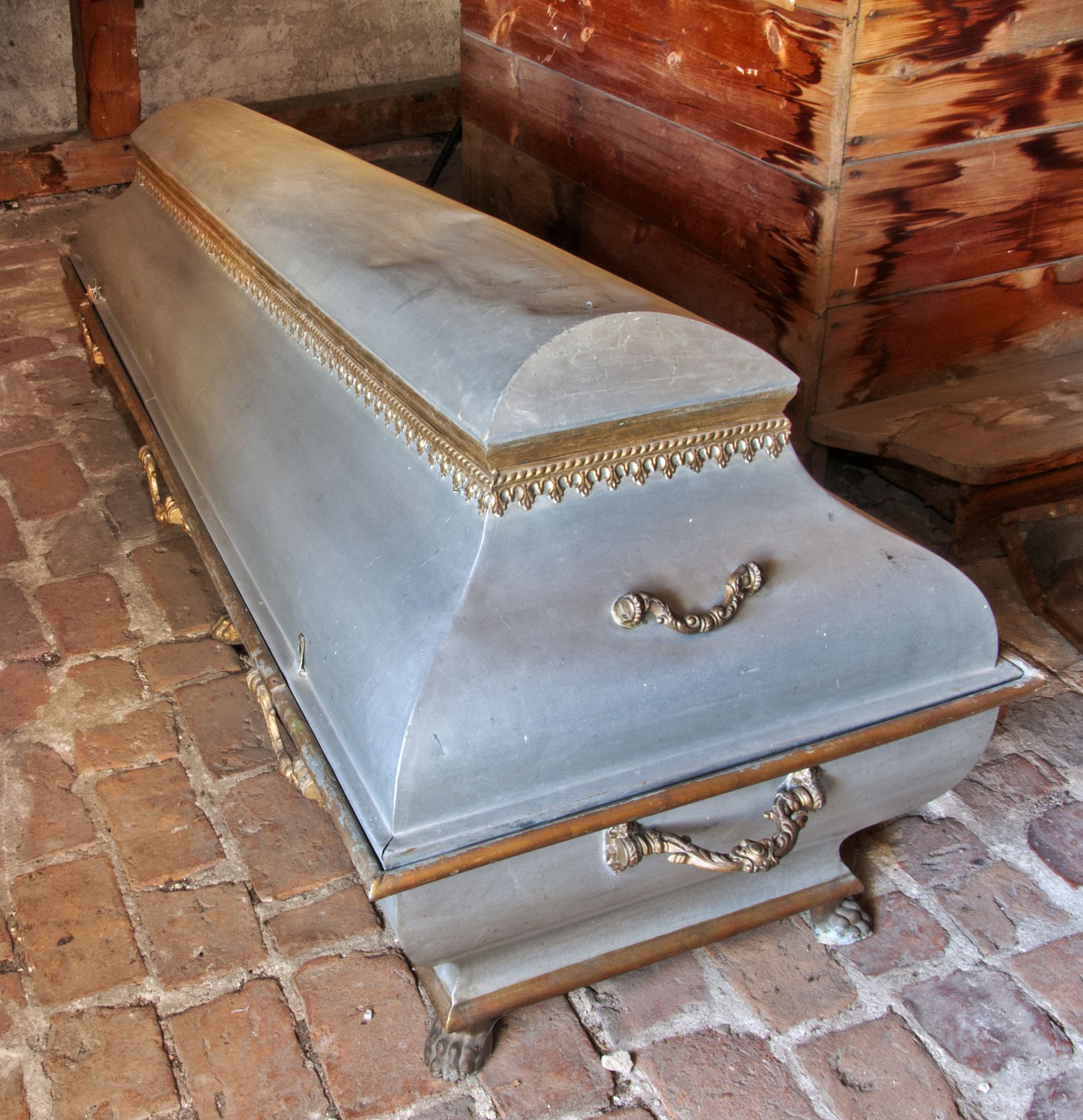
This coffin, which was manufactured to order at Victor Lång’s coffin shop around the year 1900, supposedly for the Finnish resistance movement but was never retrieved, was, according to legend, intended for a politically undesirable person. As for who that undesirable person was is not known. Because the coffin was manufactured around the year 1900, roughly contemporously with the assassination of the much-hated Nikolai Bobrikov, Governor-General of Finland at the time, which happened when Eugen Schauman, a student, civil servant and Finnish nationalist, shot and killed Bobrikov in the Senate building (today the State Council building or Government Palace) in Helsinki, in June of 1904. It thus received the nickname of ”Bobrikov’s coffin”, but no information has been found to suggest that it was manufactured specifically for that purpose. Regardless of what the coffin’s intended purpose was, Bobrikov was later buried with full state honors on the outskirts of St. Petersburg in a Russian-made coffin paid for by the state.
After the Finnish war of 1808-1809, which admiral Carl Olof Cronstedt, who had previously owned Herttoniemi manor and bought it back after the war and built the current main building, took part in and which led to the destruction of his reputation after the capitulation of Suomenlinna (Sveaborg in Swedish), Finland had existed as an autonomous grand duchy within the Russian Empire. For the first 90 years of this ”time of autonomy”, Finland and Russia coexisted largely peacefully together but during the 1890s, the Russian government came to be dominated by slavophiles who wanted to consolidate the Empire around a single shared Slavic culture and Greek-Orthodox faith, and thus eradicate all minority cultures, including Finnish culture.
This led to a series of Russification measures being initiated through the so called February Manifesto of 1899, with the intention of integrating Finland as part of the Russian Empire proper and dismantle its politial and economic autonomy by russifying the country. This very soon provoked resistance among the native population but this resistance remained largely peaceful and non-violent until 1904 when Governor-General Nikolai Bobrikov was assassinated by Eugen Schaumen in the Senate building the the centre of Helsinki. The situation became much tenser after this and Schauman’s deed inspired a string of similar assassination attempts throughout Finland; just eight months later, the pro-Russian politicial Eliel Soisalon-Soininen was murdered in his apartment by student and activist Lennart Hohenthal, who was inspired by Schauman.
After Russia’s defeat in the Russo-Japanese war of 1904-1905 which very nearly triggered a revoution in the country in 1905, the russification campaigns were halted, at least for the time being, but they resumed again in 1908 and continued up until the assassination of Russia’s prime minister Pyoter Stolypin in the Kyiv opera house in 1911. After that, Russia dropped any pretense of constitutional law and ruled Finland as a royalist dictatorship and police state until the collapse of the empire in 1917 and Finland’s independence later that year, when all russification measures ended for good.
As for what this means for ”Bobrikovs coffin” at Herttoniemo manor, there is not much on record about it and its background. As mentioned, according to tradition (or legend), it was manufactured on order for the Finnish resistance movement but was never retrieved, after which it found its way to Herttoniemi. During the first Russification campaign of 1899-1905, an activist circle gathered periodically in secret at Herttoniemi manor where they drew up plans to murder Governor-General Nikolai Bobrikov and hide his body in the coffin. Eugen Schaumen beat them to the punch, however, through his assassination of Bobrikov in June 1904. Bobrikov was transported to the Helsinki Surgical Hospital in Ullanlinna but died of his wounds the next day and was later buried with state honors in Russia. The assassination of Eliel Soisalon-Soininen eight months later was inspired by that of Bobrikov, but as for whether Lennart Hohenthal had any kind of connections to the activist circle that gathered at Herttoniemi manor is not known. Whether this story is true or not is also unknown, but it has survived as part of the collection of anecdotes and ghost stories surrounding Herttoniemi manor that often arise when reading and learning about the manor’s history.
Somewhat ironically, the last individual owner of Herttoniemi manor, John Bergbom, was also murdered at his breakfast table in 1918 by a group of Red Guards who broke into the manor, just prior to the outbreak of the Finnish Civil War that year.
References:
Bo Lönnqvist, Dödens ansikte: Tro och sed bland herre och folk, (In Swedish) (Publishing company Scriptum, 2013), s. 34 (image and text)
Iltalehti, Hyytäviä kauhukertomuksia ympäri Suomea – Uskotko näihin tarinoihin?, Iltalehtis internet site (In Finnish) (Requires logging in with an Alma account), last retrieved on 12 August 2026, (https://www.iltalehti.fi/kotimaa/a/201807012201013206)